

In probability, the binomial distribution with parameters n and p is the discrete probability distribution of the number of successes in a sequence of n independent experiments, success (with probability p) or failure (with probability q = 1 − p). A single success/failure experiment is also called a Bernoulli trial, so for a single trial, i.e., n = 1, the binomial distribution is a Bernoulli distribution.
In general, if the random variable X follows the binomial distribution with parameters n ∈ ℕ and p ∈ [0,1], we write X ~ B(n, p). The probability of getting exactly k successes in n trials is given by the probability mass function:

for k = 0, 1, 2, …, n
where 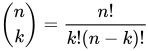

The binomial coefficients occur in many areas of mathematics, especially in the field of combinatorics. 
The formula can be understood as follows: k successes occur with probability pk and n − k failures occur with probability (1 − p)n − k. However, there can be permutations of the trials, such that the k successes can occur anywhere among the n trials; in other words, there are

If X ~ B(n, p), that is, X is a binomially distributed random variable, n being the total number of experiments and p the probability of each experiment yielding a successful result, then the expected value of X is:
![{\displaystyle \operatorname {E} [X]=np.}](https://wikimedia.org/api/rest_v1/media/math/render/svg/3f16b365410a1b23b5592c53d3ae6354f1a79aff)
For example, if n = 100, and p =1/4, then the average number of successful results will be 25.
Proof: We calculate the mean, μ, directly calculated from its definition.
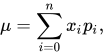
so, given the definition the proof is as it follows:

This is possible thanks to the Binomial theorem. According to the theorem, it is possible to expand the polynomial (x + y)n into a sum involving terms of the forma xb yc, where the exponents b and c are nonnegative integers with b + c = n, and the coefficient a of each term is a specific positive integer depending on n and b. For example,

The coefficient a in the term of a xb yc is known as the binomial coefficient 

It is also possible to deduce the mean from the equation 

![E[X_{i}]=p](https://wikimedia.org/api/rest_v1/media/math/render/svg/4b5168daa167785cf7b6ae656f8a9671266da3ce)
We get
![{\displaystyle E[X]=E[X_{1}+\cdots +X_{n}]=E[X_{1}]+\cdots +E[X_{n}]=\underbrace {p+\cdots +p} _{n{\text{ times}}}=np}](https://wikimedia.org/api/rest_v1/media/math/render/svg/a5b9664916594e673425c37deb40a5012c818ba1)
As well as with the mean, it will be easy to show how the Binomial Variance can be calculated. The variance is:

Proof:
Let 

Gven the Binomial distribution, there exist different derivations, which is interesting to talk about:
-
Sums of binomials
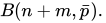
If X ~ B(n, p) and Y ~ B(m, p) are independent binomial variables with the same probability p, then X + Y is again a binomial variable; its distribution is Z=X+Y ~ B(n+m, p):
However, if X and Y do not have the same probability p, then the variance of the sum will be smaller than the variance of a binomial variable distributed as
-
Bernoulli distribution
As we said before, the Bernoulli distribution is a special case of the binomial distribution, where n = 1. Symbolically, X ~ B(1, p) has the same meaning as X ~ B(p). Conversely, any binomial distribution, B(n, p), is the distribution of the sum of n Bernoulli trials, B(p), each with the same probability p.
-
Poisson binomial distribution
The binomial distribution is a special case of the Poisson binomial distribution, or general binomial distribution, which is the distribution of a sum of n independent non-identical Bernoulli trials B(pi).
-
Normal approximation

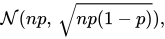
Binomial probability mass function and normal probability density function approximation for n = 6 and p = 0.5 If n is large enough, then the skew of the distribution is not too great. In this case a reasonable approximation to B(n, p) is given by the normal distribution
and this basic approximation can be improved using a suitable continuity correction. The basic approximation generally improves as n increases (at least 20) and is better when p is not near to 0 or 1.
![{\begin{aligned}\operatorname {P} (Z=k)&=\sum _{i=0}^{k}\left[{\binom {n}{i}}p^{i}(1-p)^{n-i}\right]\left[{\binom {m}{k-i}}p^{k-i}(1-p)^{m-k+i}\right]\\&={\binom {n+m}{k}}p^{k}(1-p)^{n+m-k}\end{aligned}}](https://wikimedia.org/api/rest_v1/media/math/render/svg/38fc38e9a5e2c49743f45b4dab5dae6230ab2ad5)
An interesting aspect as for the Binomial derivations are the Limiting distributions:
- Poisson limit theorem: As n approaches ∞ and p approaches 0, then the Binomial(n, p) distribution approaches the Poisson distribution with expected value λ = np.
- De Moivre–Laplace theorem: As n approaches ∞ while p remains fixed,
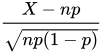
- the distribution of approaches the normal distribution with expected value 0 and variance 1.
This result is sometimes loosely stated by saying that the distribution of X is asymptotically normal with expected value np and variance np(1 − p). - This result is a specific case of the central limit theorem, about which we’ll talk in the next research.
 Rambling things