

Probability theory is the branch of mathematics concerned with probability, expressing the concepts in a rigorous mathematical manner by using a set of axioms.
Given the probability theory, we say that P(E) is a probability of some event E if P satisfies the Kolmogorov’s axioms, which are three and stated below:
- Axiom 1) The probability of an event is a non-negative real number
(with F being the event space.) This means P(E) is always finite.
- Axiom 2) The assumption of unit measure is such that at least one of the elementary events – an evet that contains only a single outcome – in the whole sample space will occur with certain probability 1.

This axiom is linked with the unitarity concept that ensure that the sum of probabilities of all possible outcomes of any event always equals 1. It’s surely clear how unitarity of a theory is necessary for its consistency. Therefore, it’s obviously needed for axioms and for probability theory to work.
- Axiom 3) The third axiom is about the assumption that any countable sequence of disjoint sets (also defined as mutually exclusive events) satisfies the following:
which is also known as the assumption of σ-additivity.
Now, given the three axioms, there are three more extremely important statements for probability theory, which are the conditional probability, the concept of independence and the subadditivity.
The conditional probability is given by Bayes‘s theorem, which describes the probability of an event basing that on prior knowledge of condiotions that might be related to the event:
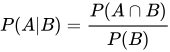
(Likewise, P(B|A) would be “observing B given A as true”.)
The interpretation of Bayes’s theorem depends on the interpretation of probability given to the terms of study. For example, in the Bayesan’s interpretation, probability measure a degree of belief, such that it’s a proposition done before and after accounting for evidence. Another interesting point of view is given by the frequentist probability, that we’ll see in another research.
The concept of independence is univocaly linked with mutually exclusive events. While dealing with them, in fact, means that it’s not possible for mutually exclusive events to occur at the same time, by definition. A simple example of this can be applied to the set of outcomes of a single coin toss, which can result in either head or tail, but never both.
In other words, Ei events are said to be mutually exclusive if the occurence of one of them implies the non-occurence of the remaining n-1 events, such that the intersection of these two sets is empty (A ∩ B) = 0 so that also the probability will be P(A ∩ B) = 0.
Given this, the union probability of two mutually exclusive events will be P(A ∪ B) = P(A) + P(B)
In mathematics, subadditivity is a property of a function which states that evaluating the function for the sum of two elements of the domain, always returns something less than or equal to the sum of the function’s values at each element.


(It’s interesting to know how the subadditivity can also be related to the triangular inequality 
In measure-theoretic terms, following the fact that a measure is σ-subadditive, this concept can be linked with the Boole’s inequality. The Boole’s inequality – also known as the union bound – says that for any finite or countable set of events, the probability that at least one of the events happens isn’t greater than the sum of the probabilities of all the individual events, as it follows:
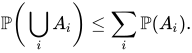
Finally, Boole’s inequality can also be generalised to find upper and lower bound on the probability of the finite unions of events.
Lastly, as we said before, the law of large numbers is the link between probability and frequency. In the next research, we’ll see how even the probability axioms can be expressed using the relative frequency definition.
Glossary:
Axiom:= a statement that is taken to be true, to serve as a premise for further reasoning and arguments.
synonnyms: maxim, precet, theorem, adage.
Mutually exclusive:=two propositions (or events) are mutually exclusive or disjoint if they cannot both be true (occur).
synonyms: independent, discriminative, selection, preferential.
Subadditivity:= a property of a function that states, roughly, that evaluating the function for the sum of two elements of the domain always returns something less than or equal to the sum of the function’s values at each element.
synonyms: —
Bound:= upper and lower bounds, observed limits of mathematical functions
synonyms: blockade, confines, enclosure, fence, obstacle, stop.
 Rambling things