
Depending on the context, the mean has several different definitions.
In probability and statistics, population “mean” and “expected value” are used synonymously to refer to one measure of the central tendency, either of a probability distribution or of the random variable characterized by that, as we’ve already seen in this article. It is also known as the expected value.

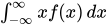
On the other hand, for a data set, the terms arithmetic mean (and sometimes average) is used to refer to a central value of a discrete set of numbers, in particular the sum of the values divided by the number of values.
It’s typically denoted by 

In mathematics, the geometric mean is a type of average, which indicates the central tendency or typical value of a set of numbers by using the product of their values (as opposed to the arithmetic mean which uses their sum).
So, to give a proper definition of that too, the arithmetic mean is the sum of a collection of numbers divided by the number of numbers in the collection.
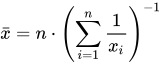
The harmonic mean is an average which is useful for sets of numbers which are defined in relation to some unit, for example speed (distance per unit of time).
The weighted arithmetic mean is used if one wants to combine average values from samples of the same population with different sample sizes:
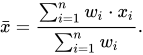
The weights 
The word mean doesn’t have an precise meaning yet, adn the different means shown here aren’t the only ones available, as there exist a lot of more heterogeneous average computations both in the arithmetic and statistical science.
 Rambling things